Sunday, September 13, 2015

Prague

Prague is a city best enjoyed with your significant other, but when offered a chance by my employer to attend a conference of Indian bond dealers there, I said yes right away.

Flying Turkish airlines and changing flights at Istanbul, I reached the hotel in Prague (a Hilton business hotel not too far from the old town center) around 3 pm in the afternoon. The conference managers had organized an orientation tour of the city that evening, but I decided to explore myself at my pace, on my own whims.


I set out for the Old Town Square, but lost my way and hit Wenceslas square instead, a wide boulevard culminating in the statue of Saint Wenceslas and the national museum at one end, and lined with office buildings, hotels, retail stores and strip clubs. The area sported a typical festive summer atmosphere. The crowd was a mix of locals and tourists, and a concert setup was in the works.

From Wenceslas square, I passed through narrow cobblestoned streets lined with cafés and boutiques to reach the Old Town Square. On one side of it was the pretty Tyn church and the opposite side, the Tower Hall with its astronomical clock. Both the church and hall were closed for the day, but I could go up the bell tower to get a panoramic view of the city.
 

From the town square, I headed north to the Jewish quarter, where a few old synagogues stood among high end retail stores. At one of the synagogues I bumped into the orientation tour group and joined it for a bit. The tour then headed back to the town square, whereby a couple of friends and I split from the group and enjoyed some Skaroramen beers at one of the cafés at the square.

Later that evening a river cruise was organized for the conference attendees. While some river / bay cruises, such as the ones in New York, Istanbul and Sydney, give you a different view of the city that cannot be had from being on land, a majority of cruises the world over are tourist traps with bad buffets. This one belonged to the latter category, though it was fun having a few drinks with colleagues in the industry.


After the cruise, I took an overnight bus to Budapest for a really short trip and was back the next night at 1am. (see my blog Budapest and Bratislava .. In a day!) The day after that was the actual conference. I attended the morning session and then headed out to the explore the Castle district.

Located on the other side of the Vltava, the Prague castle is the foremost attraction in the city. I bought a ticket that covered the four main attractions in the complex. I first headed to St Vitus Cathedral, a Gothic masterpiece considered the best building in Prague. The tall vaulted ceiling and large stained glass works were very impressive. Across the Cathedral were the Basilica and the Royal Palace and while they have historical significance, aesthetically they were uninteresting. The fourth entry on the ticket was the Golden Lane, lined with houses of commoners - Tarot card readers, goldsmiths, cavalrymen - across the past few centuries. Some houses are now converted to shops while yet others have exhibits related to their occupants. The slight drizzle that was on since the morning had by now turned into a downpour and I was getting soaked, having forgotten to carry any rainwear.

I had to buy a separate ticket to visit the bell tower of St Vitus Cathedral, which gave a nice view of the city including the old town square on the other side of the river. As I exited the castle area from the other side, I noticed a tavern, went in and took the only table available.  I ordered the homemade dark beer, and then had a look at the menu - to realize that this place had been open since 1350 and Mozart had been a guest at some point of time. A British couple from Liverpool joined me at the table and informed me that this was the oldest tavern in town and they had put in some effort to find it. Lucky me to have randomly bumped into it ! Their Liverpool accent was really tough to follow, but I managed to have a bit of a conversation about football and work and travel. With the refill of the beer, I also ordered for some baked Camembert cheese, which turned out to be quite delicious. True to it's medieval origins, the tavern had no wifi, the waiters banged the beer glass on the wooden table rather than serve it on a coaster gently. When I visited the washroom situated in the basement, I noticed that the ceiling was covered with human skulls!  The cost of enjoying two pints of homemade beer and fine cheese at this 600 year old tavern was less than having an average cocktail in an average bar in Mumbai.


The rain had stopped when I left the tavern. I walked through Mala Strana (lesser quarter) , where ethnic Germans lived in the Middle Ages. I thought of going into the well regarded St Nicholas Church, but I felt I had seen enough churches in the last couple of days and decided to save a few Korunas instead.

I crossed over the pretty Karluv Most (Charles Bridge) to the other side of town and roamed about for a bit, looking for places where I could spend the late evening - after attending the conference Gala dinner. I spotted a Jazz club and a couple of black light theaters. Just within a few blocks, there seemed to be half a dozen churches playing organ concerts. One could spend a week in this city visiting museums during the day and enjoying good music in the evenings.

Walking around, I ended up in Wenceslas square again and picked up a stylish leather backpack for my wife. I then took the metro back to the hotel, changed into smart casuals and boarded the bus headed to Zofin Palace, the venue for the gala dinner. It was a beautiful neo-Renaissance style building on a small island on the Vltava, connected to the mainland by a small footbridge. The food was average, but a Violin duo playing some classics including Pachelbel's canon was the highlight of the evening's entertainment. Chatting with friends and colleagues, I stuck around at Zofin till the event wound up around midnight, and by then it was too late to find any jazz or theatre.

I had a couple of hours in the morning to explore the town before heading to the airport, but the constant drizzle dampened my spirit and I just loafed around the hotel, having a long breakfast and chatting with friends.

I had barely scratched the surface of this beautiful city in the two half days I had to explore it. I will go back for more as soon as I can!
 

Budapest and Bratislava ... in a day!

In an ideal world of unlimited holidays, one should spend at least a full day in Bratislava, and 3-4 days in Budapest to soak in the beauty, culture and nightlife these Eastern European capital cities have on offer. But even a glimpse is better than nothing, and I thus planned a hectic 24 hour side-trip to these places from Prague, where I was attending a conference and had a day off.


Post a Vltava river cruise with the Indian banking fraternity that ended at 10 pm, I had a quick change of clothes at the hotel and walked to the nearby Florenc bus station to take the overnight bus to Budapest. It was drizzling when I reached there at 5:30 am: thankfully I was carrying an unopened poncho I had bought at the Singapore GP 3 years ago. A Spanish tourist about to leave town gave me his 24 hour ticket for the public transport system. It would last till midday which suited me perfectly. I had a falafel sandwich for breakfast at the metro station to kick start the day.

My first stop of the day was the Deak Ter station, the heart of Pest. I walked South west on Karlovy Korut, one of the major thoroughfares with trendy cafés, shops and old world architecture. Just a few blocks away was the Great Synagogue, built using the Moorish style and the largest in Europe. It was still just 7 am and the building wasn't open to visitors yet. A couple of bars on Karlovy Korut, however, were open and abuzz with revelers.
Retracing my steps back to Deak Ter station and walking a block further, I reached St Stephen's Basilica, perhaps one of the most impressive buildings in all of Eastern Europe. There was barely a soul inside and I could walk around admiring it's massive dome and neo-Renaissance architecture in total peace. Building regulations in Budapest restrict any building to be taller than the dome of the Basilica. A short walk along Andrassy Avenue - considered Budapest's answer to Shawn Élysées - got me to the Budapest Opera, another neo-Renaissance masterpiece. It still wasn't even 8 am and thus even the box office wasn't open yet.

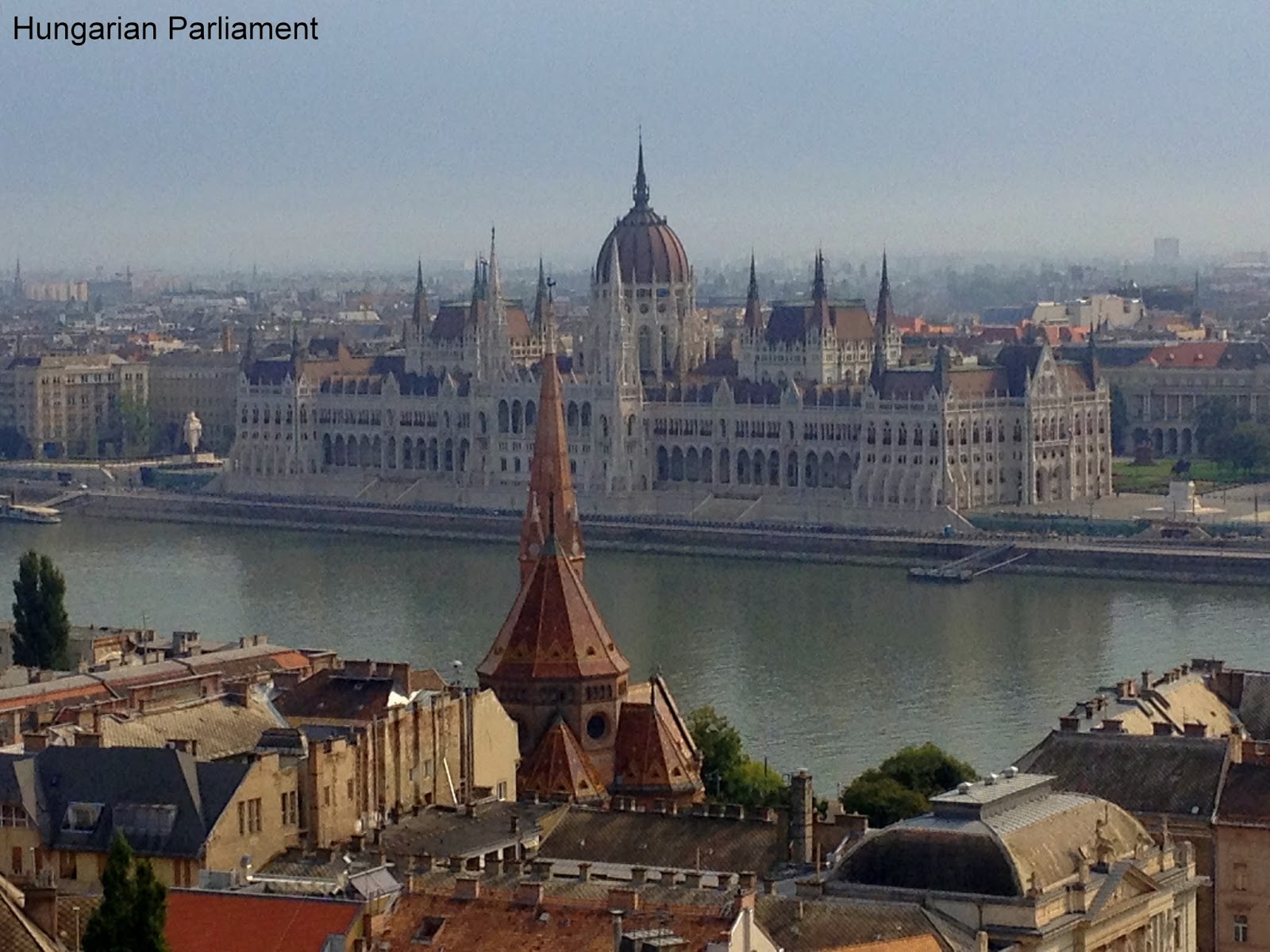
I then took the metro to Vorosmarty square, one of the most happening plazas in Pest, but at that moment, deserted. From the square I walked along the cobblestoned Vaci street, lined with boutiques and quaint restaurants as well as the regulation Starbucks, McDonalds and Burger King. At some point I turned towards the Danube river to views of the Buda Castle on the opposite bank. I crossed over the famous Chain bridge to the Buda side and climbed the couple of hundred steps to reach the Gothic St Mathias Church. I couldn't enter as Sunday Mass was going on, but I took the tour of the Bell tower. The top afforded a 360 degree panoramic view of both Buda and Pest, with the highlight being the sight of the Hungarian Parliament - as tall as St Stephens, no more no less - on the opposite side of the Danube.

The guide for the tour, Arpad, was a fan of Bollywood. He told me he liked SRK, but his favorite movie was Pyaasa. Then he went on to explain to me how it represented the class divide in India. I love the movie too, but this guy had a different way of experiencing it. It happens most times I travel - I end up meeting someone who talks about India in a way Indians don't.

After descending from the wall tower, I visited the Fisherman's Bastion. The name doesn't give any clues about the building - as per it's website, it is "a panoramic viewing terrace with fairy tale towers". An Asian couple was getting wedding pictures clicked, and with the sun out now, the setting couldn't be any better. I could hear Strauss' The Blue Danube ringing in my ears !

There were a couple of interesting places to visit in the neighborhood: the "Hospital in a rock", a nuclear era bunker, and "Labirinthus", an underground network of pathways and caves.  But time constraints meant I couldn't visit either of them. I walked to the Buda castle, situated a few blocks away at the same panoramic elevation as the church and bastion. Though it looked impressive from a distance, it wasn't as beguiling up close as other places I had seen that day. Moreover it had been badly damaged during WWII. It houses a well known museum but I didn't have the time to visit it.
In many ways Budapest offers similar attractions to most European cities: castles, plazas, art museums, opera etc. What sets it apart are it's  public baths with their sauna, hot pools and array of spa treatments housed in impressive classical buildings. From the Buda Castle, I took a bus across from Buda to Pest and then a metro to one of the city's top attractions,  the Szechenyi baths. I was quite impressed by it's locker system. When paying for entry, you received a remote device that you wore like a watch and which could be used to lock whichever locker you choose to keep your stuff in. In case you forgot the locker number, then there was another device around where you could scan your watch and it would flash your locker number. I spent close to an hour at the baths, rejuvenating my tired feet.

I left the baths at around 1 pm and headed to the central market with a view to have lunch there and perhaps pick up a souvenir or two, but it was shut for some reason. I had a nice potato soup at a joint across the street and headed back to the bus station.

I barely spent 6-7 hours in town, but got a good flavor of things on offer. The city was as pretty as any in Europe, but tourist numbers were much less than you'd find in Paris, Rome or even nearby Prague. A few travel websites are spot on when they say that Budapest is one of the hidden gems of Europe. I felt that a few parts of the city were dirty, but I guess that is line with Eastern Europe still catching up with the Western part in terms of prosperity. One observation reminded me of Mumbai's suburban train network - there were no ticket turnstiles at underground stations.

I boarded a bus at 3 pm and reached Bratislava at 5:45 pm. I had earlier considered spending a few hours more at Budapest and leave at 6 pm to reach Prague past midnight. But Bratislava was on the way and I thought it would be nice to break the journey into two parts, be somewhere fun during dinner time, and peek into the Slovakian capital even if just for a couple of hours.


The 10-15 minute walk from the bus station to old town was through a residential neighborhood - it was deserted and everyone was indoors as one would expect on a Sunday evening. I came across a neighborhood church, painted blue both on the outside and inside, and filled with locals. A few minutes later I reached the old town square which was full of activity thanks to the tourists. The castle and the main church in town were closed for the day. While they probably were worth a peek, the town didn't have any must-see attractions. A few blocks from the Town square was the Danube riverside, lined predominantly by modern glass facades, with the odd building with classical architecture.

For dinner, I picked a place serving Slovak specialities. What I ordered had a Slovak name I forgot, but it was a sweet-savory dish consisting of four plum-stuffed large Gnocchi balls, covered with a sweet sauce containing poppy seeds. Given how meat dominated Eastern European food is, I had discounted any possibility of enjoying the local food, but authentic experiences are even more enjoyable when they come up unexpected.


After an eventful day I took the 8:30 pm bus back to Prague reaching there at 1 am . The bus, run by a company called Student Agency, not only did have an entertainment system, but also free hot drinks served by a hostess on board. For all the fun I had, the total damage was less than 100 Euros!


Monday, June 15, 2015

Morocco Part IV: Rabat and Casablanca

...continued from Morocco Part III: In and Around Fes
 
The next morning I took the 6:30 am train to Rabat. I slept a bit, worked on the blog and enjoyed the green hills, reaching Rabat at 10 am. Alongside Fes and Marrakech, Rabat too was an ancient capital, though of lesser importance. Another UNESCO World Heritage site, it is the capital of the Kingdom of Morocco today, and combines the ancient and modern elements: the old Medina, the colonial French buildings and modern trams.  A short walk from the train station took me past the gates of Rabat's small medina and to the guesthouse, Riad Dar Soufa. It was one of the top two places to stay in the city, and the decor lived up to my expectations. My room was oblong shaped with the bed at one end, a sitting area in the middle and an open bathroom at the other end, with an option to draw a curtain for privacy.

The host Benoit was a cheerful young Frenchman and he gave me a map and a few pointers. I strolled about the medina for a bit - many shops were closed as it was a Friday. There were one too many pizzerias along the main thoroughfare for my taste, but perhaps there was a demand for them here. Only a sloping strip of land separated the medina from the Atlantic Ocean. In any other city, this strip of land would be infested with hotels and restaurants, but here it was one cemetery after another. I guess that's one way of honoring the dead: give them a prime plot of land after they're gone.


A short walk from the cemetery took me to Kasbah de Oudiais, an old settlement at the estuary of the small river separating Rabat from it's major suburb Salle. The upper and lower halves of the walls here were painted white and blue respectively, giving the neighborhood a distinct flavour.


Thereafter I walked along the river to reach the Mausoleum of Mohammed V, Morocco's King during the latter half of the 20th century. Besides the saints, his name seemed to be the most used to name monuments. I couldn't walk up the steps of the Mausoleum as they were about to shut it for the Friday afternoon Namaaz. On the other end of the plaza was the well regarded Hassan Tower, but it was undergoing restoration and thereby closed to visitors.

I had pizza for lunch at a restaurant named Zumba, and then took the tram to the Rabat train station to visit the Museum of Morocco a block away. It had one floor dedicated to Morocco's history between 9th and 14th centuries, a time when the cities of Fes, Marrakech and Rabat were found under the rule of the Idrisses, Almoravids, Almohads and Merinids. 

The descriptions of displayed objects were only in Arabic and French, but there was English commentary for the major events. The other two floors exhibited work of Modern Moroccan artists. One interesting exhibit was one where the audience had to pass through a room filled with plastic bottles hanging from the ceiling into another room littered with waste and finally into another room where a human figure was made with plastic bottles.

A 15 minute walk away was the complex of Chellah, the necropolis of the Merinid dynasty. It was also one of the venues for a music festival - different from the one in Fes - starting that day. Hoping to get some information about the fest from two gentlemen who were discussing it, I started with a polite enquiry and ended up having a 45 minute conversation with them. One of them was a Frenchman from Marseille who had disposed his father's ashes in Varanasi and hoped someone did the same for him when his time was up. Within a week now, I had met two Frenchmen who spoke about Varanasi the way Indians speak about New York or London, and I had never visited India's holiest city. The other one was a black man who grew up in Edison, New Jersey, and thus knew a fair bit about Indian culture. We talked about what brought me to Morocco, how travel invigorates the soul, the distorted way in which the west views the east, the growing North African population in Marseille, and the otherworldliness of Tokyo. 


On the way back to the guesthouse I ran into a theatre that was one of the venues of the music festival. An Iraqi band was playing and I bought a ticket for the show due to start an hour later. I dropped my camera at the room, had a quick dinner and reached the venue twenty minutes before show time to get good seats. Ironically I was the first one to arrive and there were just 25-odd people who showed up all evening, 24 of whom were seemed to be either Iraqis or journalists. The vocalist was accompanied by two percussionists, a keyboard player and one who played a santoor like instrument, though using both sets of fingers to play it. The vocalist was quite good, though the music got repetitive after a while and I was too tired to concentrate. The old gentleman seated next to me however was enjoying the concert like it was Jagjit Singh and Ghulam Ali singing together.  There were a few open air concerts as well around the rest of Rabat, including one by Jennifer Lopez which had no entry fee. But I was too exhausted to enjoy any music while standing, even if JLo was performing, and headed back to the guesthouse.

For breakfast the next morning, I applied a mixture of cream cheese and black olive spread over the crepes, which worked out quite well. There was the usual mint tea, OJ, yogurt and fruit to go with that. I then checked out and took a train to Casablanca. This stretch of the railway was the busiest in the country, with the side of the tracks overflowing with litter and some slums all equipped with satellite receivers dotting the landscape. 


When I had started planning my trip, I had the impression, thanks to the movie, that Casablanca would be one hell of a place. On further research I realized that the movie was shot in a studio in Los Angeles, and Casa was just a big bustling commercial city with 6 million people. There was a Rick's Cafe, but a fake one that opened post the movie's success. There was such a dearth of attractions in Casa Blanca that King Hassan II, who ruled towards the end of the twentieth century, decreed the building of a impressive mosque, to be named after him. It is the third largest in the world, second only to the ones at Mecca and Medina. My only agenda for the day was to visit it before heading to the airport for the return flight home.

From the Casa Port station in Casa Blanca, I hailed a cab to the nearby bus terminal which, as per the net, was the only place where one could store luggage. Apparently the storage facility was closed down 6 years ago, but the ticket clerk found me a cargo porter who would take care of the luggage for a small tip. 


I had missed the morning's guided tours at the Mosque - they were the only way a non-Muslim could go inside - so had a couple of hours in hand before the 3 pm tour. I took the tram to L'Oasis station to visit the Museum of Moroccan Judaism. Most people in the neighborhood had no clue where it was, but a local shopkeeper managed to explain to me, using hand signals, that I had to make the first left, fourth right and second left. He was spot on. I however missed a trick - the museum was closed for the day, presumably because of Sabbath. So I hiked back to the tram station, and took one to Place Mohammad V  to visit a private museum run by some Glaoui Foundation. It's major attraction was posters made by French masters in the 19th century to advertise travel to North Africa and Constantinople. Glassware, china and jewelry from the Orient made the balance of the display in this residence-turned-museum. 

A short cab ride brought me to the Hassan II Mosque. It was huge for sure, and had a tall minaret, but I wasn't overawed. It had a rectangular structure and a flat roof as opposed to a dome that I think of when I think of great Muslim architecture such as the Taj or Sultanehmat Mosque. Rather than a mastery of engineering, it seemed more a display of wealth, with all citizens having to chip in for it's construction cost of 800 million dollars. The interiors of the mosque were magnificent though, with it's wide corridors, huge arches and intricate cedar wood panels.
 
 
I skipped the guided tour midway to get back to the bus station at 4 pm, the deadline my luggage keeper had given me as his shift ended then. The cab I took was vacated by an Indian family living in West Africa, the only Indians I came across during my entire trip. I reached the airport, named after who else but King Mohammad V, four hours before the flight time. It was a badly designed and confusing airport even given it's small size. A look at the Air Morocco destination chart showed that Casablanca was a major hub for flights between Europe and North and West Africa. The departure screen was both a tongue twister and a lesson in geography, with destinations like Nouakchott, Douala via Yaounde, and Ouadougou. As much fun as I had during the past week, I couldn't wait to get onto the flight in anticipation of seeing family after a week.
 
The trip worked out to be much cheaper than I had imagined. There is only so much one can spend here. Finding a place that serves alcohol is a task. Even the best Riads go for 5-6k a night. Taxis are cheap, and so is the food.. 

Given the good time I had, I was surprised that very few non-French tourists come here. Maybe the locals' lack of fluency in English is a factor. The lack of English displays at museums and monuments is also a minor irritant. I also asked myself, is it a must visit place ? The mosques aren't as grand as in Istanbul, the palaces not as impressive as in India, the Atlas Mountains ain't the Himalayas or the Andes, and once one gets bored of Tagines and Couscous, there is only pizza and sandwiches to fall back upon. The need for women to dress modestly compared to the West or South East Asia is also a factor to consider. While it can be considered quite exotic, the traditional markets are withering away. It's one thing to be approached by someone who offers to show you around, but when a regular local young man turns into a guide the moment you ask a question, one feels irritated and years for some authenticity. Nevertheless, I had a great time overall and would wholeheartedly recommend Morocco to friends. 


Wednesday, June 10, 2015

Morocco Part III: In and around Fes

...continued from Part II: Around Marrakech
 
The journey wasn't very comfortable. Legroom was limited. Strangely enough they charged me a small amount for putting my small suitcase in the storage compartment. I slept in bits and pieces, and spoke a bit to my neighbor, a journalism and videography student on his way to Rabat . His brother was due to appear in an exam there and had forgotten some of his books. I reached Fes early at 5:30 am in the morning and had a delicious bean soup for breakfast at one of the stalls at the bus terminal. It was probably a staple breakfast there as many of the locals were having it as well.

Right across the bus stand was the entrance to the Fes Medina. All buildings here were a shade of cream, lighter than the colours in Marrakech. It took me 15 minutes to find my guesthouse, Dar El Bali. The host was kind enough to give me an 
8 am check in. The courtyard was highly ornate, and the room was beautifully decorated. The coffee table contained a display of antique knives and jewelry. The bathroom tissue roll hung on a Berber statue, seeming as if it was a drum being played. I had some tea - served in a cutting chai type of glass  - and left for exploring the surroundings. 

I took the public bus to Meknes, another Moroccan medina that's part of UNESCO's world heritage list and situated on one of the verdant rolling hills that characterized the northern part of the country. I visited the tomb of a certain Moulay (saint) Ismail and checked out the Dar Jamai museum which had a good exhibit of clothes, weapons, jewelry etc.  The displays there, as in most other places, were only in Arabic and French, leaving no room for the Queen's language. Given the proximity to Spain, some people spoke Spanish and I managed to have a barebones conversation with a police officer regarding directions.
 
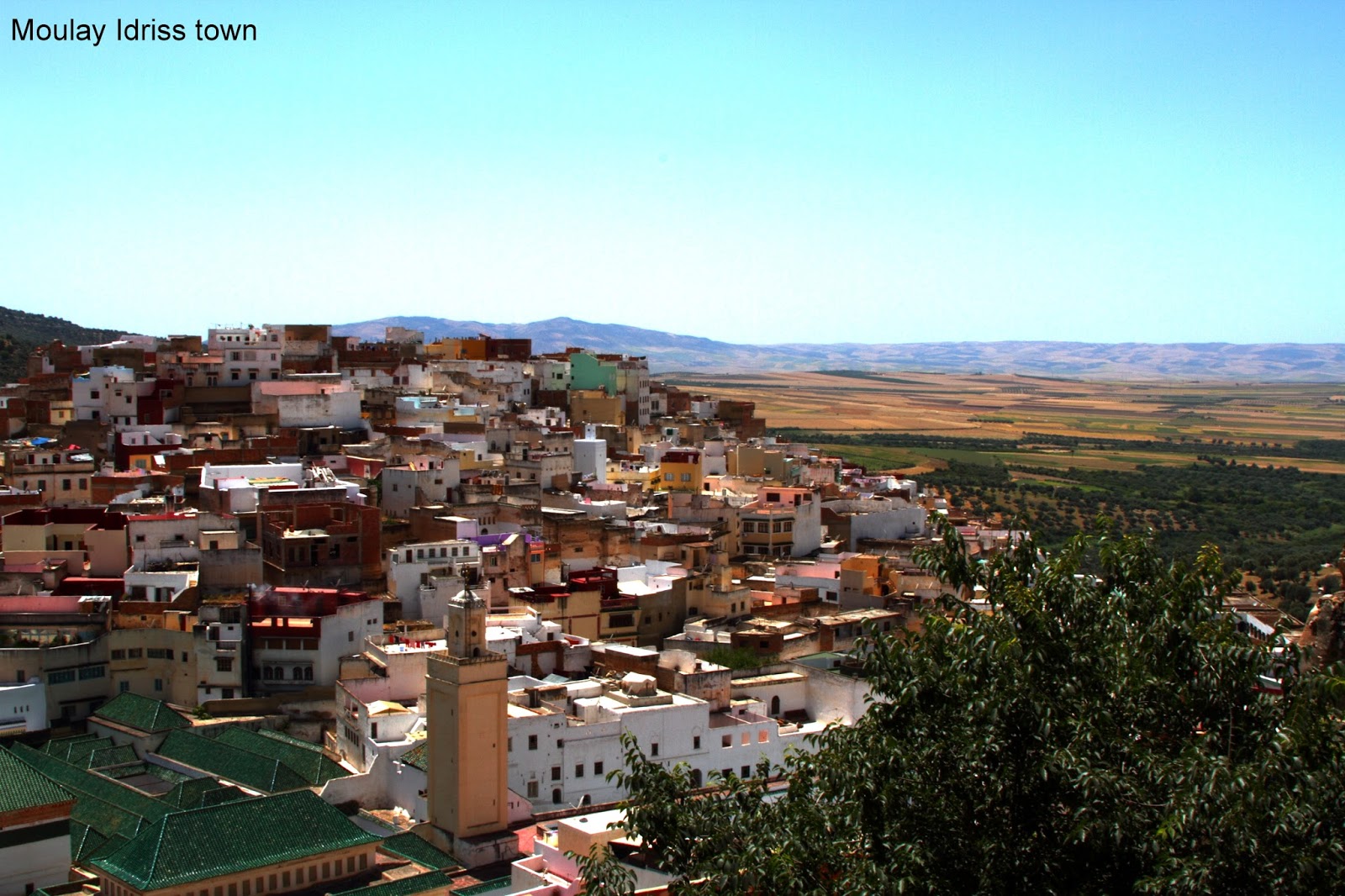
After strolling about in the Medina for a while, I had a sandwich and fries lunch, and took the city bus to the small town of Moulay Idriss. Passing through the newer parts of Meknes, I realized that houses even in the modern parts of Moroccan cities weren't more than 3-4 floors tall. Perched on a hill slope 25 km from Meknes,  Moulay Idriss houses the tomb of Morocco's most important saint Idriss and is thereby the most holy site in the country. Consequently , non-Muslims are not allowed to spend the night there. They aren't allowed to visit the interior of the tomb either, so I walked up to the top of the town to get the heart beat going and get a nice view in the bargain.
 
 
Since I was in the mood for walking, I decide to hike the 4 km distance to the nearby site of Volubilis, a Roman ruin. It had all you would expect from a Roman city: temples, a forum, a basilica, communal latrines, a brothel and good plumbing. Quite a few of the columns and arches were intact. This site too was part of UNESCO's heritage list. The trip back to Meknes was a long one: taxi back to Moulay Idriss, city bus back to Meknes and the long distance bus to Fes. The latter thankfully took the expressway and didn't make 50 stops on the way like the bus I took in the morning. 

A music fest was going on in the plaza outside the Fes medina walls, and the area was teeming with shoppers even as there seemed to be little sign of the music starting anytime soon. I had dinner at a restaurant recommended by the guesthouse, Cafe Genuoune. They served me a lentil soup gratis as I waited for my order of a vegetarian Tagine. The soup was delicious and the Tagine tasted good too. The carrots seemed to have gained a distinctive taste. But there is only so much one can have of a dish that has just carrots, potatoes, beans and olives. For vegetarians I think it is better to stick to couscous with vegetables. I was very tired after the long day and went to bed by 
9 pm, glad that I had a proper bed instead of an uncomfortable bus seat. 

The next day's plan was to explore Fes, the earliest major capital of Morocco, the most populated car-free urban area in the world and at one time considered to be the largest city in the world. No prizes for guessing that Fes is on the UNESCO list as well. 

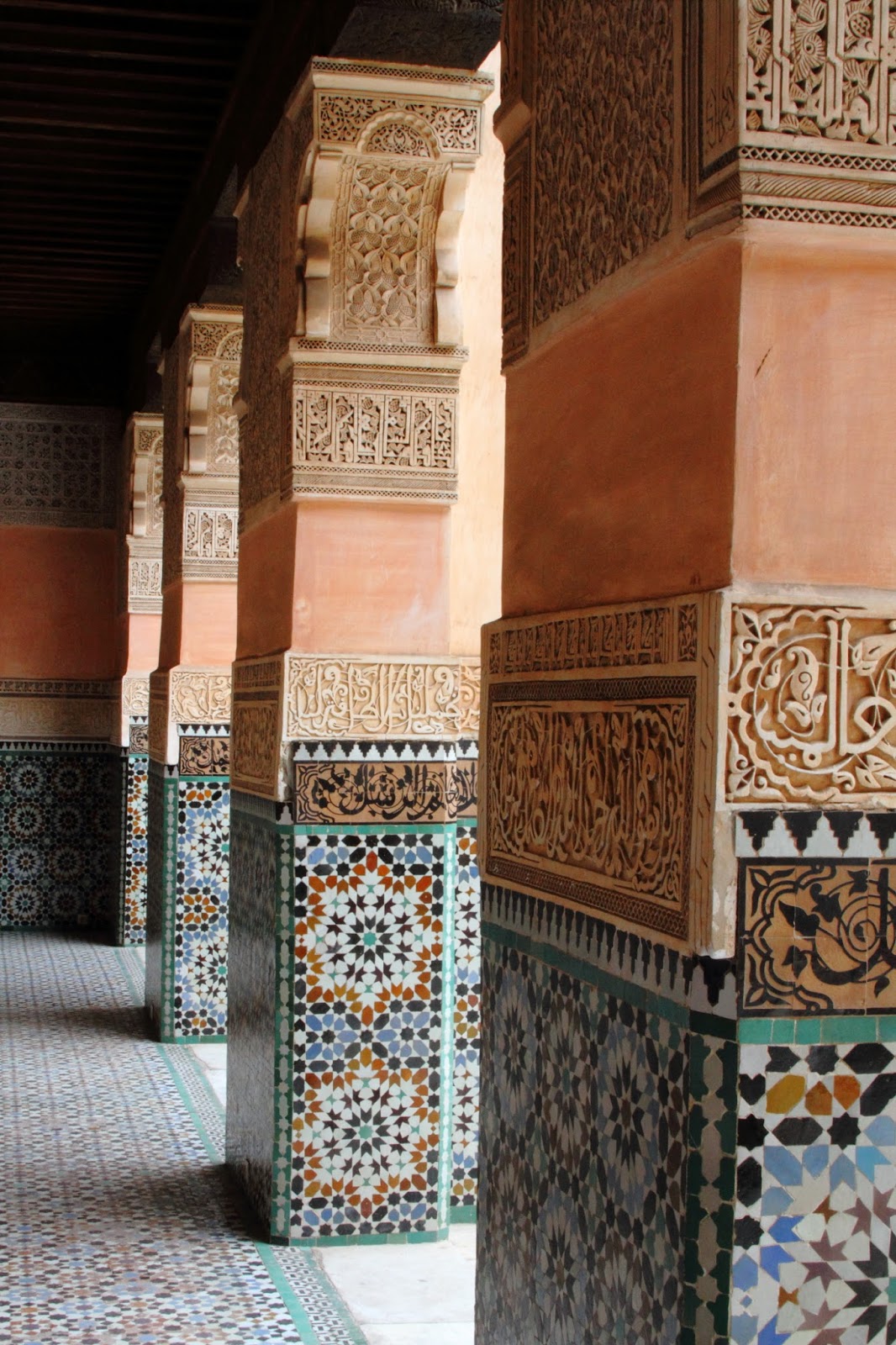
The first stop of the day was a visit to the Bou Inania Madarssa, smaller than the Ben Yousef Madarssa in Marrakech, but similar in design - ornate doors and arches, marble columns, floor and lower wall covered by ceramic tiles,  the middle wall by plaster carvings, and the upper wall with intricate  woodwork. This was one of the earliest schools in the country and it's design become the gold standard for others to emulate.

Making my way through Talaa Gebira, one of the major thoroughfares in the Medina, I passed the Souk Attarine, once the biggest spice market in the world but now overrun by shops selling cheap sunglasses and fake handbags. At the center of town, I visited the Attarsine Medersa and then looked to find one of the tanneries that Fes is well known for. I would have managed to find myself, but I got one of the locals to guide me to one in exchange for a small tip. It seemed a few hundred people made their living by guiding lost souls through the maze of the old city. I was visiting a tannery for the first time. I was a given a few mint leaves to smell during the visit to keep off the disgusting odours. One of the shop workers took me to the terrace where I got a bird's eye view of the process: washing of the hide in a rotary drum, removal of hair in vats filled with calcium carbonate, and then dyeing in another set of vats using natural ingredients, one of which was pigeon poop - its purpose was to soften the leather. On one side, some hides were being saffron dyed one at a time by two men, a labour intensive process that made them expensive. 


After the tannery visit, and skipping it's associated shop, I headed to the Andalusian Quarter. I was disappointed to find it no different from the rest of town, and headed back to the center of town where there were a few mosques and mausoleums that non-Muslims like me were peeking into. At every one of them a young man or boy would approach me and offer to take me to some nearby terrace from where I could get a good view of the monument. If I asked them if they were a guide, they'd all give the same reply: I am no guide, I am a student.

Walking about, I reached Talaa Sagira, the other major thoroughfare. I bought a small wall piece, the kind wherein decorative doors cover a mirror. I dropped it at the guesthouse, checked my email and then headed out to explore Fes el Jdid. Taking it's name from the Jews (Jdid) who settled there, it is often referred to as new Fes, though "new" still means a few hundred years old. The first Fes was thereafter called Fes El Bali (old Fes) . En route, I passed the gardens of Jnane Sbil, which were nice and tranquil, but nothing to crow about. Fes el Jdid itself had little to offer, except a 300 year old synagogue, which had to be specially opened by a woman who lived next door.  I hope that most of the 20 dirhams she took an entry fee was really for the upkeep of the place rather than a "convenience charge" for her. I also had to tip the boy who called her from her home. 


At one end of Fes el Jdid was the Royal Palace, but one could only admire the doors and imagine the interiors. I retraced my steps through the new city and the garden to reach the high recommended Batha museum, only to realize that it was one of the venues for the music fest and the exhibits were thus closed early for the day. I thought it would be fun to watch the concert instead and bought a ticket.

There was still an hour to go for the
4:30 pm concert and I went for a stroll. I saw a Hamam and figured I didn't have much to do post the concert and made a reservation. As soon as I stepped out of it's premises, a tout approached me and offered to take me to another hamam for half the price. It was a tantalizing offer, but I wondered if it could be a shady place and declined.

The concert consisted of a quartet of piano, saxophone, a traditional string instrument that looked like a guitar but sounded like a sitar, and a set of traditional drums. I had no idea of the context of the music as the piano player gave some commentary in French, but I overheard names like Mendelssohn and Tchaikovsky. The way I understood it, it was  a good mix of classical, jazz and traditional themes. The highlight though was enjoying the music while lying down on the carpet laid out between the stage and the seats, in the middle of museum garden. It threatened to rain but never did, though the strong gusts had leaves strewn over the audience.

Post the show I scrapped the Hamam plan and went shopping instead. I almost bought what I thought to be a table lamp but it turned out to be an incense burner. I checked out hand embroidered table runners and napkins, but they were quite expensive, and I couldn't be sure they were handmade. Finally I ended up just buying a top for Jyoti. For dinner I had what I like to call a kitchen sink sandwich: besides the usual veggies, it had rice, fries, and potato bhajias. Adjacent to the sandwich store was a cigarette stall with a poster of Shahrukh Khan of the 90s. The odd shop in the Medina played songs from DDLJ and K2H2.


... continued in Part IV: Rabat and Casablanca


Morocco Part II: Around Marrakech

...continued from Morroco Part I: Discovering Marrakech
 
I couldn't sleep too well that night: it usually happens to me during the first 2-3 days of a trip due to excitement. I woke up at 4:30, checked work email, called Jyoti, worked on this blog and went down for breakfast at 6:30. It was a hearty meal of traditional bread with honey, cream-filled crossaint, fruit pie, some other type of bread and some other sweet concoction. At 7 am I was picked up for the day trip to the Atlas Mountains, visiting the 1000 year old village (kasbah) of Ait Ben Haddou and the new city of Ouazarzate.

I was the only non Frenchperson in the group of 7. One of the guys had spent six months in Varanasi in an orphanage and another girl had spent a month in Nepal with another NGO. Every time I travel, I end up meeting Europeans who have worked for a month or more with an NGO in South Asia.  When I asked the Varanasi guy where he was from he said Nice and then went about explaining where it was in France. I quipped that my sister and a friend were in Nice for a vacation at that time. We Indians crave for French glamour and they are enchanted by our spirituality. 


The winding drive through the mountains made me a little nauseated. The drive was nice but not out of the world. Moreover the landscape was barren: give me a green landscape and I can keep watching for hours and hours. We reached Ait Ben Haddou around noon. A lot of movies such as Gladiator, prince of Persia , Lawrence of Arabia, Babel, Indiana Jones etc. were shot here. Only 10 families live here while the rest had moved to a modern village across the river. We had to cross the river to get there and the locals had made a bridge of large stones. It was tricky to cross and young boys came to your aid and held your hands, demanding a steep 10 dirhams after you crossed. The old kasbah was perched on a hillside, with the houses having a foundation of stone, walls of brick and a wooden roof. Many Jews lived in Morocco at one point of time and there was a synagogue in the complex. This place was a major stop for caravans coming from the Sahara carrying salt. There was a modern bridge to cross the river back to the car park: the crossing by the stone bridge was just to ensure some income for the boys. Our guide remarked that the construction of the bridge had taken income away from mule drivers who took supplies across the river. 


The guy from Nice and his wife stayed behind in Ait Ben Haddou and the rest of the pack headed to Ouarzazate, a new city whose main attraction was film studios and a museum of cinema. The driver parked at the city center, and the group split into two: I joined the Parisian girl who had volunteered in Nepal and her friend from Bordeaux who lived on a farm and rode horses for fun. We took a walk through an old Kasbah nearby. Our guide was a young local boy who kept cracking jokes, which of course I didn't understand. The girls were nice enough to translate, for my benefit, some of the information he gave.

A four hour drive bought us back to Marrakech by 
7:30. I picked up a margarita pizza for dinner. At 20 dirhams (130 rupees) for a 10 inch pizza, it was the cheapest pizza I've had anywhere in the world, and it wasn't too bad. I had planned to get the traditional hamam and spa treatment for the evening, but was tired and sleepy, and called it an early day.

The next morning's breakfast was served in the terrace. Some of the small touches at the Riad were quite memorable. The breakfast table was decorated with rose petals, candles were put in the room before I had arrived the previous evening and my clothes were nearly folded or hung in the closet. At 4k rupees a night this place was a steal. Clearing the bill proved a little tricky though. To settle the EUR 115 due, I gave Niza three 50 EUR bills and she went in Ghizlane's room and came back with change in Dirhams. As per my math she owned by 350 dirhams but she came out with 450: 2 notes of 200 in one hand and one of 50 in another. I much later realized that she meant that take this 400 and give me 50 back to make it 350, but at point in time I was clueless what she was trying to indicate. I asked her if she could wake up Ghizlane, but she wouldn't get out of bed and kept giving directions from there, and Niza would keep flitting in and our of her room. Finally I made the payment partly in Euros and partly in Dirham in a manner all of us understood. I left my luggage at the Riad, to be picked up in the evening and joined the tour to the sea side town of Essouira. 


Unlike the previous day, this journey was on a flat 4 lane highway. En route we stopped at an Argan co-operative farm and factory. Argan is a Moroccan oil which can be used both for cooking and as a body oil. We saw the women removing the skin from the fruit, and then crushing it into oil. The prices here were much higher than I had paid at Marrakech for a small bottle of oil and a bar of soap: either what I had bought was substandard, perhaps fake, or this place was one of those scams that display some random certificates, pay commissions to drivers who bring business and overcharge gullible customers. 
At 11:30 the minibus reached Essouira, whose Medina is listed on UNESCO's world heritage list. I walked around the port first, photographing the hundreds of seagulls flying about, as the fishermen were unloading their catch and selling them to the locals. The outer walls of the medina were lined with canon pointing out at sea. Blue and white dominated, as if this place were a poor man's Mykonos. There weren't any particular buildings to see - the idea was to just walk around, look, eat and shop. I found a nice fast food place, and ordered a falafel sandwich, which came with fries. This was the only city during the trip where I got falafel. I picked up a wooden jewelry box, 2 bowls, a lamp with Berber designs made using henna, and something that can be approximately described as three miniature Tagine vessels joined at the hip. It could be used for serving 3 different sauces at one go. 


During these three days, I had many locals asking me if I was from India and when I answered in the affirmative, they rattled off names of famous Bollywood actors. Shahrukh, expectedly was the número uno: apparently he attends the Marrakech film festival quite frequently. The next few names that cropped up were Dharmendra, Shashi Kapoor and Mithun Chakraborty. One of the guys broke into a "I am a disco dancer" gig. I recalled a similar event in New York when the cashier at a Senegalese restaurant had tried to imitate the peerless Mithunda.  
 
The tour bus departed for Marrakech at 4 pm, and rain delayed our arrival in town. I had the same pizza at the same place as the previous evening, rushed to the Riad, charged the phone, changed into dry clothes, and re-packed the luggage to accommodate the shopping. In the bargain, I dropped one of the bowls and it shattered to pieces. Thankfully the rain stopped after a while and I could walk peacefully to the bus station to board the overnight bus to Fes
 
..continued in Morocco Part III: In and around Fes  


Morocco Part I: Discovering Marrakech


Following my move from Singapore to Mumbai, the travel focus shifted from South East Asia to Africa and Europe. Earlier this May, I traveled with Jyoti and Ishaan to Mauritius for 5 days of sun, sea and sand, with a bit of culture and diving for good measure.

For the 1-week mid year vacation, Jyoti wanted to visit her parents in Jamshedpur with Ishaan, so I had to pick a place she wouldn't mind me traveling alone to.  I considered Albania and the Baltic states, but finally settled on Morocco.  Now which wife would allow her husband to travel to an exotic romantic place alone ?  One with a morbid fear of snakes. Jyoti so wanted to see Morocco but she had heard of the presence of snake charmers in the souks - she is so terrified of them that even one sighting a day would make the trip a nightmare.

For the trip in late May, I booked flights to Casablanca (via Dubai on Emirates) in early March. I got them cheap: I had been checking flights to
Morocco for a while and at 50k, fares were at their lowest. On Sat, May 23, Jyoti and I left home within an hour of each other, one headed to endure the 45 degree heat of the Indian Summer, and the other to enjoy the charms of old civilization. 


I saw 2001: A Space Odyssey on the flight to Dubai. I enjoyed it, but such a great movie must be seen on the big screen, or atleast a 40 inch LED. The Priority Pass got me access to the Marhaba Lounge at Dubai Airport. I am not one of those whose only posts on Facebook are the ones involving checking in to an Airport lounge or expensive hotel. I mention the stopover at the lounge as it struck me that most visitors there were Indians: presumably all Citibank Premier Miles and HDFC Signature card holders. The food on offer was thereby predominantly Indian too, including veg biryani with cucumber raita, and basmati rice with dal palak.

The second leg from Dubai to Casablanca was 8 hours. People are always surprised it takes longer to travel to Morocco from Dubai than say Paris: seeing the spherical earth on a flat map creates these distortions. I got a nice view of Dubai during takeoff. My sister lives there: in fact she had taken a plane to South of France just that morning, but we missed each other at the airport. I saw how little greenery was there , and wondered if I'd be depressed if I had to live here.

Before the flight, I had checked out the film options on Emirates and made a list of some classics (using IMDB top 250) I wanted to see. Alternating with naps, I saw a couple of French films - Amelie and Three Colours: Red. It kind of gelled with the fact that I was making a trip to an erstwhile French protectorate. It was interesting to look out of the window every few minutes. The flight went over the great Arabian desert , mostly all sand except the odd patch of green, and then flew over, in succession, the Sinai pensinsula, Gulf of Aqaba, Cairo, Alexandria, southern parts of the Mediterranean Sea, Tunis and Algiers. 


Immigration at Casa Blanca airport was friendly and quick. I collected my bags, changed some USD into Moroccan Dirhams and got onto the train to Casa Port, the city center train station. A 5 minute cab ride got me to my hotel. In hindsight I realized I had paid 50 dirhams for a 10 dirham ride, but typically the first ride in a foreign country always tends to be expensive, especially if it's after dark.

I slept at 11 and woke up 
at 4:30 am to take the train to Marrakech. The cabbie that morning, just like the one the previous night, was a fan of Shahrukh Khan. I got to the station about an hour before the scheduled departure time.  There was a chill in the air and I had to wear a sweater as I started working on this blog while waiting at the platform.

The train ride was comfortable, eight seats to a compartment. The Moroccans seemed to be simple people: well mannered, non intrusive. Some spoke French, while some conversed in Arabic or perhaps the local Berber language. The ride was through rolling hills covered with light brown fields being ploughed by donkeys , dry scrubland grazed upon by cattle, and the odd orchard that broke the brown monotony.


The train chugged into Marrakech at 10:30 and I couldn't wait to find out what made this place the no. 1 city to visit in 2015 on Tripadvisor. How do I describe it but to mention the places it reminded me of? A little like Jaipur with it's walls (albeit the color of sand rather than pink) , a little like Calcutta with it's bylanes, a little like Istanbul with it's vibrant markets selling spices and lamps. A short taxi ride from the station took me through the gates of the Medina ( walled city) and the last stretch to the Riad (a traditional home converted to a guesthouse) had to be covered by foot.

Named Riad Gallery 49, it was a little tricky to find but I tracked the house numbers and finally got there. It had an inviting courtyard with a quaint seating area, and the guest rooms and hamam were on the first floor . Lamp shades, carved wood panels and chairs, carpets, Berber motifs , brass teapots, ceramic pots and pans with Arabic calligraphy, and traditional shoes hung on the wall made up the decor. Two young ladies welcomed me, offered me tea and local sweets. Only one of them, Ghizlane, spoke English and gave me a brief orientation of Marrakech. Her colleague Niza then offered to walk me to the Main Square, Jemaa El Fnaa, and help me buy a local SIM card enroute. Ghizlane told me it was unwise to chat with Niza while on the road as the police would mind. I don't think that was the real reason. These girls were dressed up like Western women and it seemed to me that they were a misfit within the society around, and thus didn't want to attract attention of the locals.  In any case, Niza didn't speak English, so our interaction was limited to smiles.
 
Jemaa El Fnaa was buzzing with snake charmers. Between a couple of dozen of them, there were more than a hundred snakes on display. There were stalls to apply henna and a couple of monkey shows were going on. Being an Indian, this wasn't what I would call exotic, but it was a good place to hang around. Thereafter I walked through one of the bazaars, Souk Semarine, onto Ben Yousef Madarssa, a section of which was open for the public. It had a stunning marble courtyard surrounded by study rooms both on the ground and first floors and its arched entrances and balconies were adorned with intricate wood and stone work.
 
The next stop was Bahia palace, with similar architectural themes as the Madarssa, though all of it was open to viewing and thereby it seemed much bigger. The intricate lattices and wooden ceilings with mother of pearl inlays reminded of the palaces and forts in Agra and Jaipur. Adjacent to the Bahia palace was the older Badii palace, where little remained but the tall walls, with stork nests perched atop them. The palace complex also held the Minbar (the stepped pedestal atop which the priest gives his sermon) of the nearby Koutobia Mosque, one of the most important mosques in Morocco and like most others barring a couple, closed to non-Muslims. 

 
A short taxi ride took me to Jardin Marjorelle, the highest rated attraction in Marrakech. Having seen many botanical gardens around the world and some of the best Japanese and Chinese gardens,  I didn't expect much from this place. The 50 dirham entry also seemed to be steep compares to the 10 dirham charge at previous attractions. The garden though lived up to its billing. Juxtaposed with cactus and palm trees from different parts of the world were the man made elements such as blue pavilions, yellow ochre window panes, rust benches and colored pots. It was built in memory of Yves Saint Laurent and there was a room dedicated to an exhibition of his poster art.  

I then headed back to the hotel and en route, picked up a bus ticket for Fes, a trip due two days later. The plan was to take an overnight train, but it was no longer operational so I had to improvise. I was presented tea and dates upon arrival. I lazed around in the room for a but and then headed back to Jemaa El Fnaa for dinner. It was a lot more crowded in the evening. Unlike other famous squares in the world- too many to name here - this place was dominated by locals. Many shows were going on and I couldn't fathom much of it. One guy had a carpet with some coins on it and kept talking with the encircling crowd without really doing anything I could fathom, and I soon lost patience. At another place, two boxers seemed ready for battle which never seemed to start. The moment I took the camera out to take a pic, one of the gang approached me for money. Some bands were playing, a couple old men were trying to dance like Michael Jackson and there were the usual snake charmers. A couple of hundred food stalls were operating. About 50 of them were selling juices: orange juice was 4 dirhams and all the others were 10. I had veg couscous at one of the stalls that advertised itself as being recommended by a certain guidebook: it was decent but not delicious.

Back at the Riad, I called it an early night 
at 9 pm. I was rudely awaken at 10 pm by the sound of loud traditional music. Coming out of the room, I saw Niza was dressed in a belly dancing outfit and was shaking a leg with one of the guests. As tired as I was, it would have been unreasonable to begrudge the 4 other lodgers at the Riad their evening of entertainment so I splashed some water in my eyes and joined the merriment.
 
 
Continued in Part II..